ZEITGEIST
ZEITGEIST consists of seven textile wall hangings that together form a single, closed narrative. The series traces the stages of a reckoning: from initial self-deception through decline to the abyss, where a decisive rupture forces reconstruction — a return to the old status quo, but in new garb and with new insight. The arc closes. And that is precisely the point: it closes only in order to begin again.
ZEITGEIST, 2026
Series of seven parts
Full-colour digital print on duchesse satin, hand-sewn borders and hems, custom aluminium wall mounts
140 × 200 cm each
Statement of the artist
ZEITGEIST consists of seven textile wall hangings that together form a single, closed narrative. The series traces the stages of a reckoning: from initial self-deception through decline to the abyss, where a decisive rupture forces reconstruction — a return to the old status quo, but in new garb and with new insight. The arc closes. And that is precisely the point: it closes only in order to begin again.
For ZEITGEIST argues that in the late-digital present there is no Pleroma left to return to — no final redemption, no exit from the cycle. There is only the next patch. Every insight won becomes a rung for the next descent. What classical Gnosticism imagined as a singular homecoming tips over here into eternal recurrence — Nietzsche crossed with the update cycle.
The work draws on the idea of a tech-gnosis, borrowing from late-antique religious philosophy and Gnosticism and their dualism: a distant, transcendent God set against a lesser creator god, the Demiurge. In the ancient sources this Demiurge is above all ignorant and arrogant. ZEITGEIST deliberately recasts him — as the seductive creator god of the feed: the algorithm, the platform, the dopamine loop. He lures us and leaves us wavering between emptiness (Kenoma) and fullness. His instruments are technosolutionism, media addiction, consumption, greenwashing.
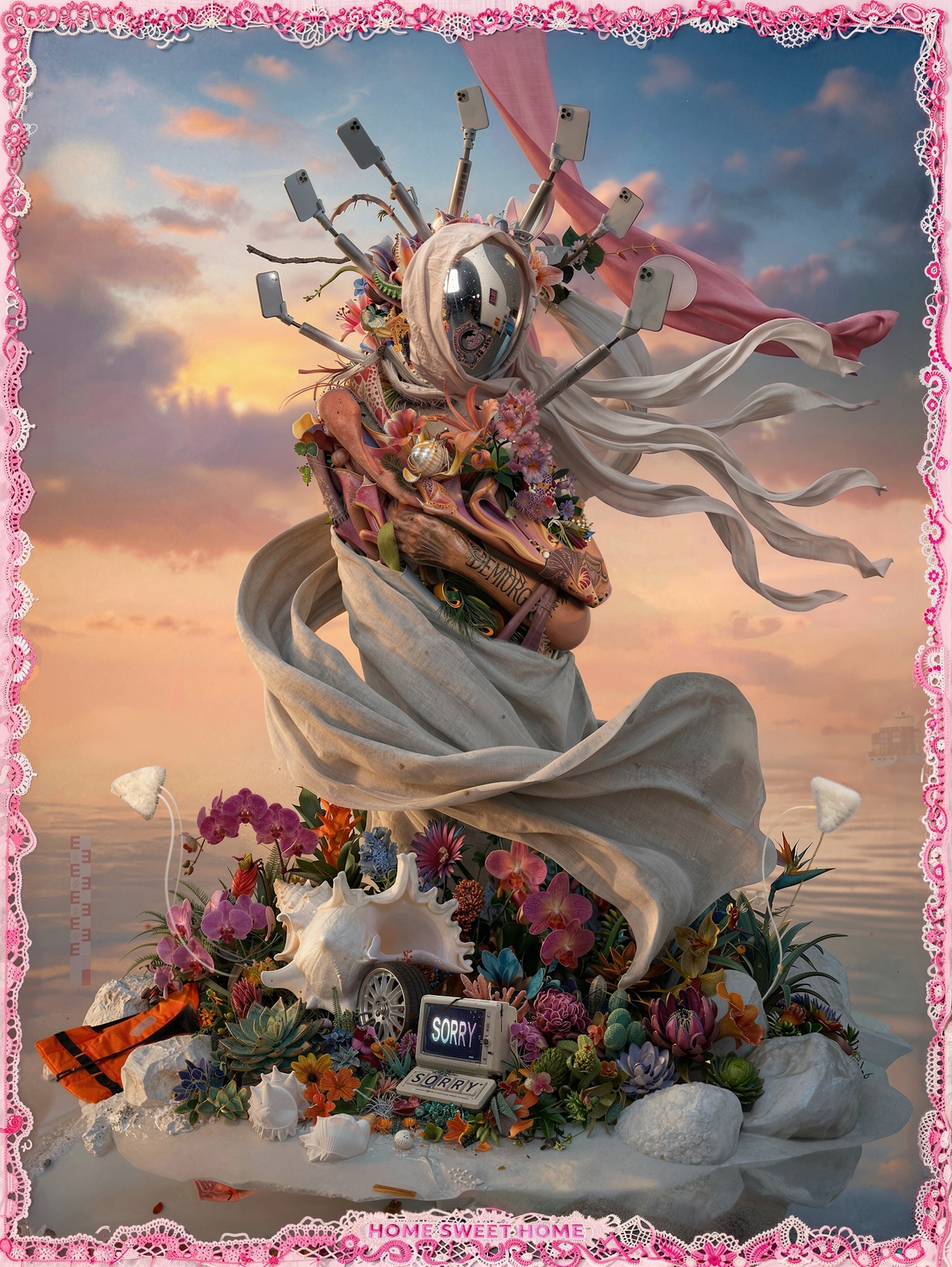
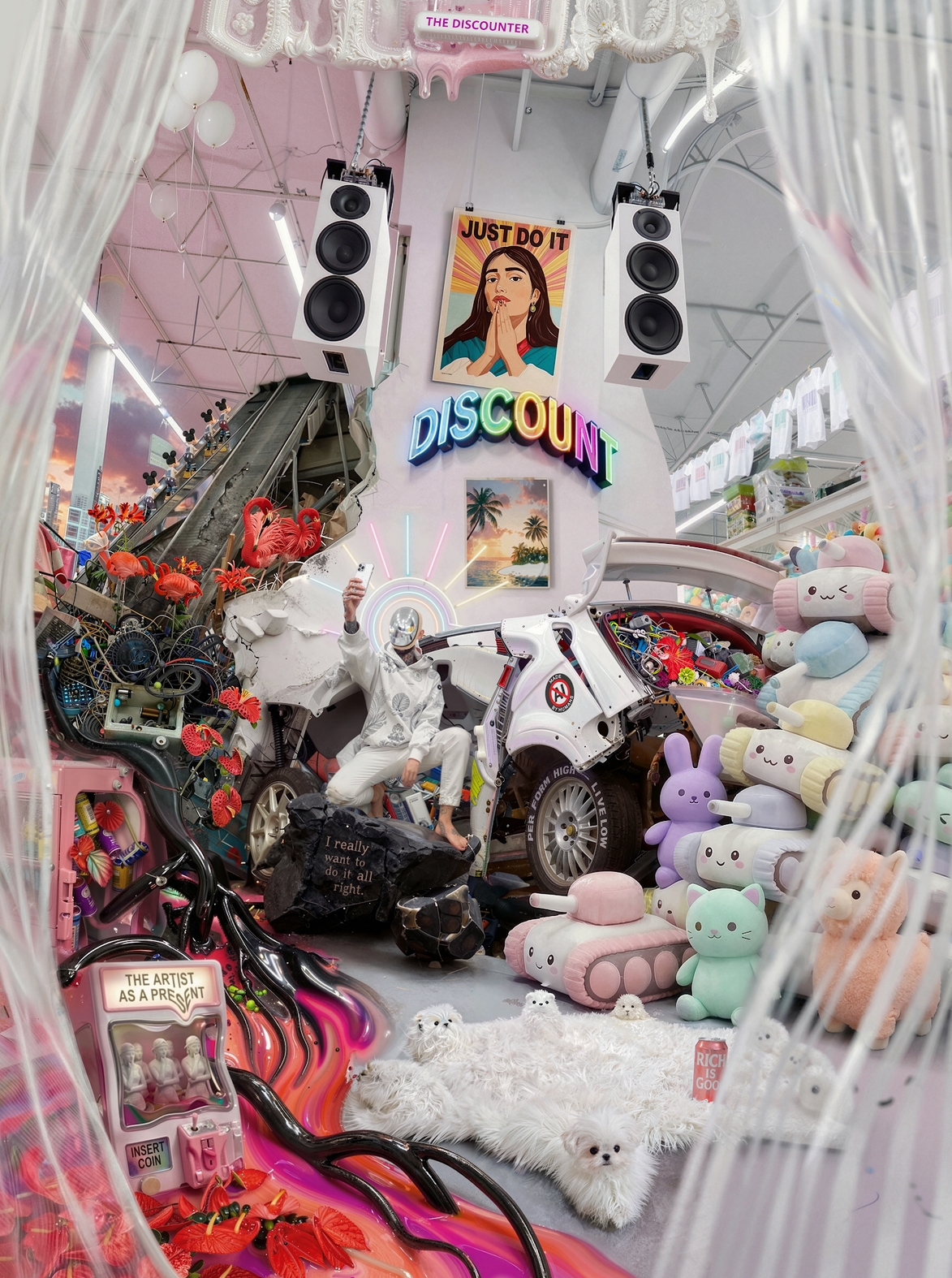
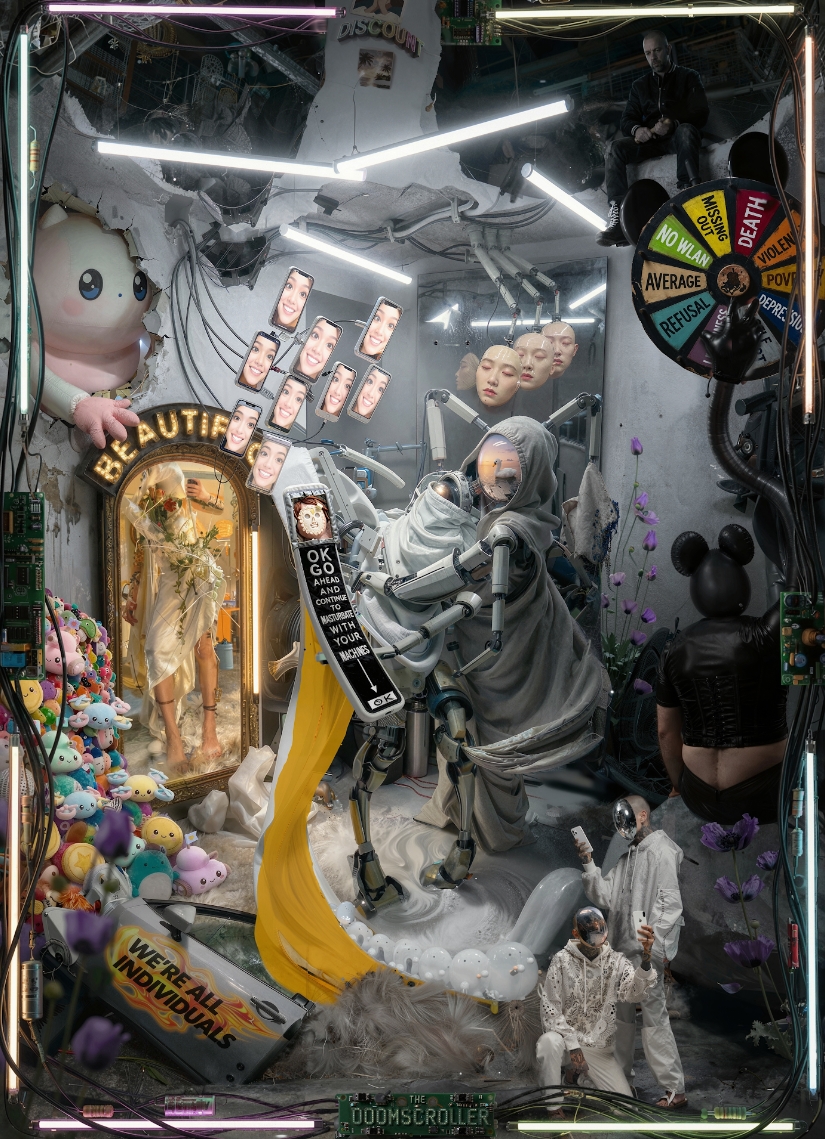
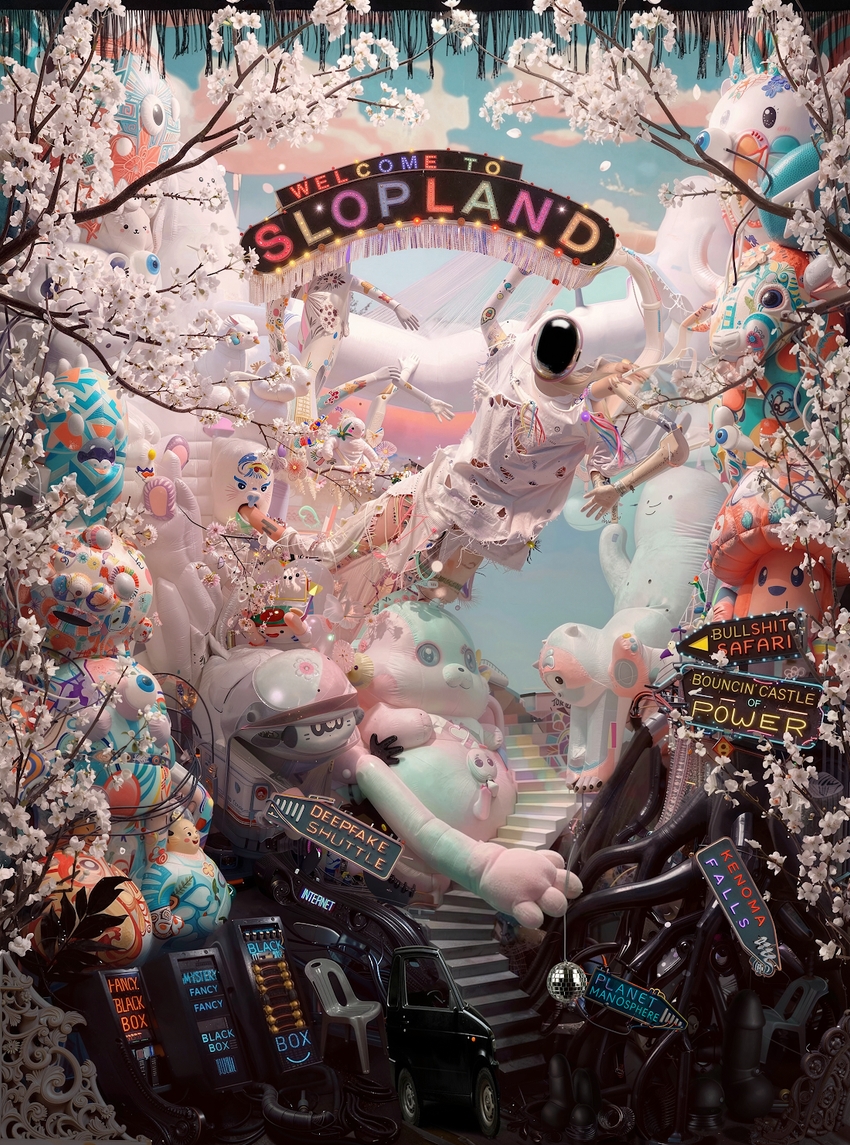
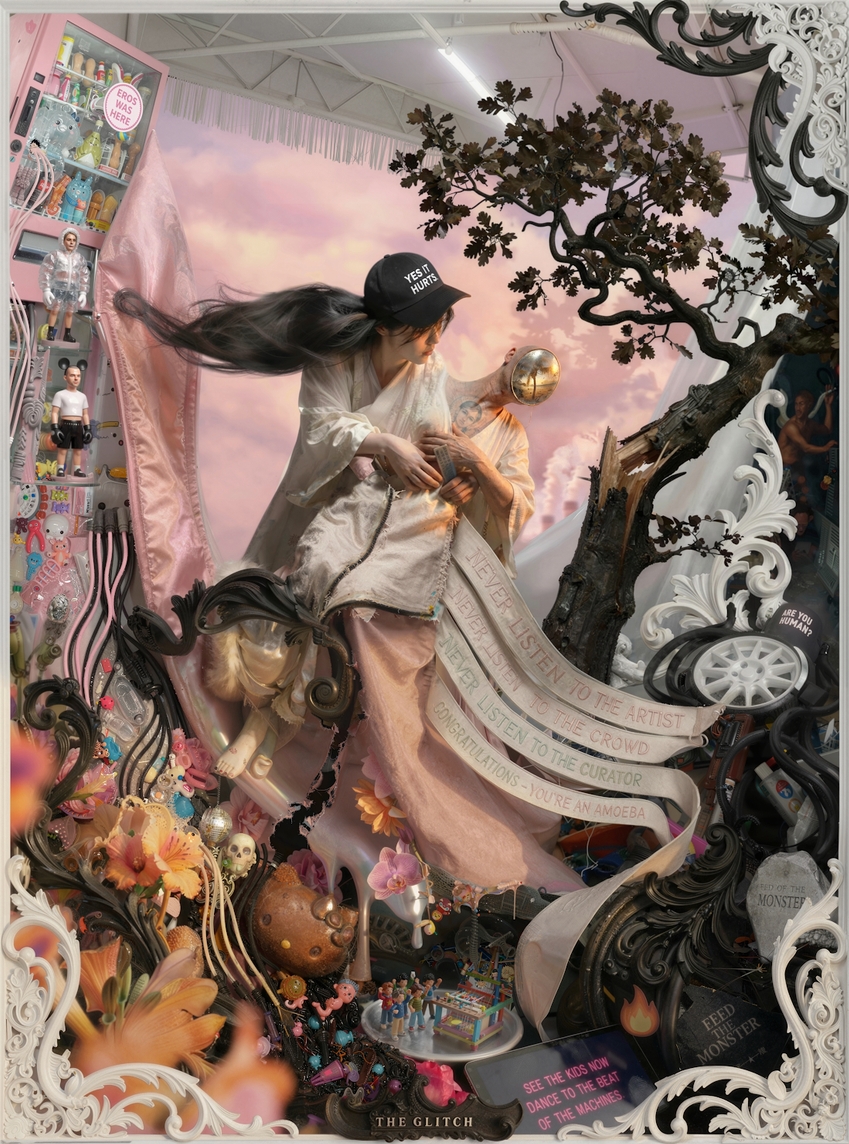
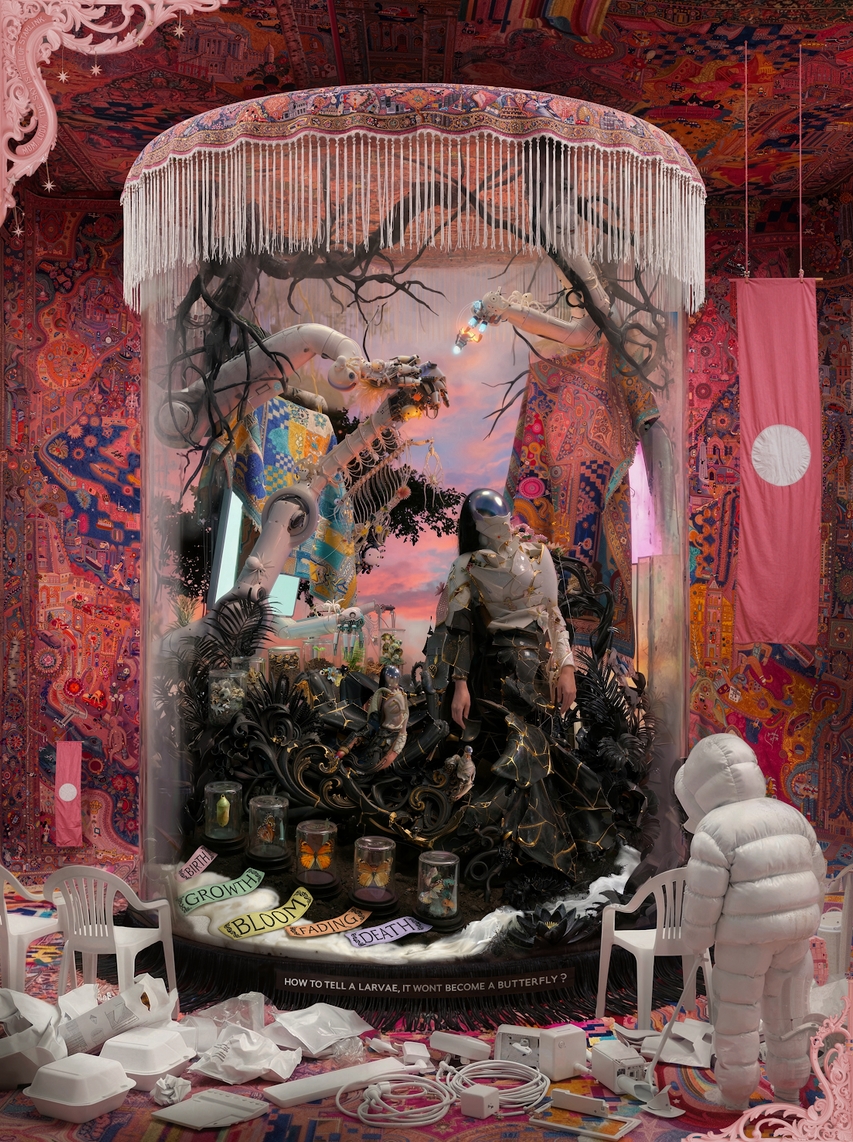
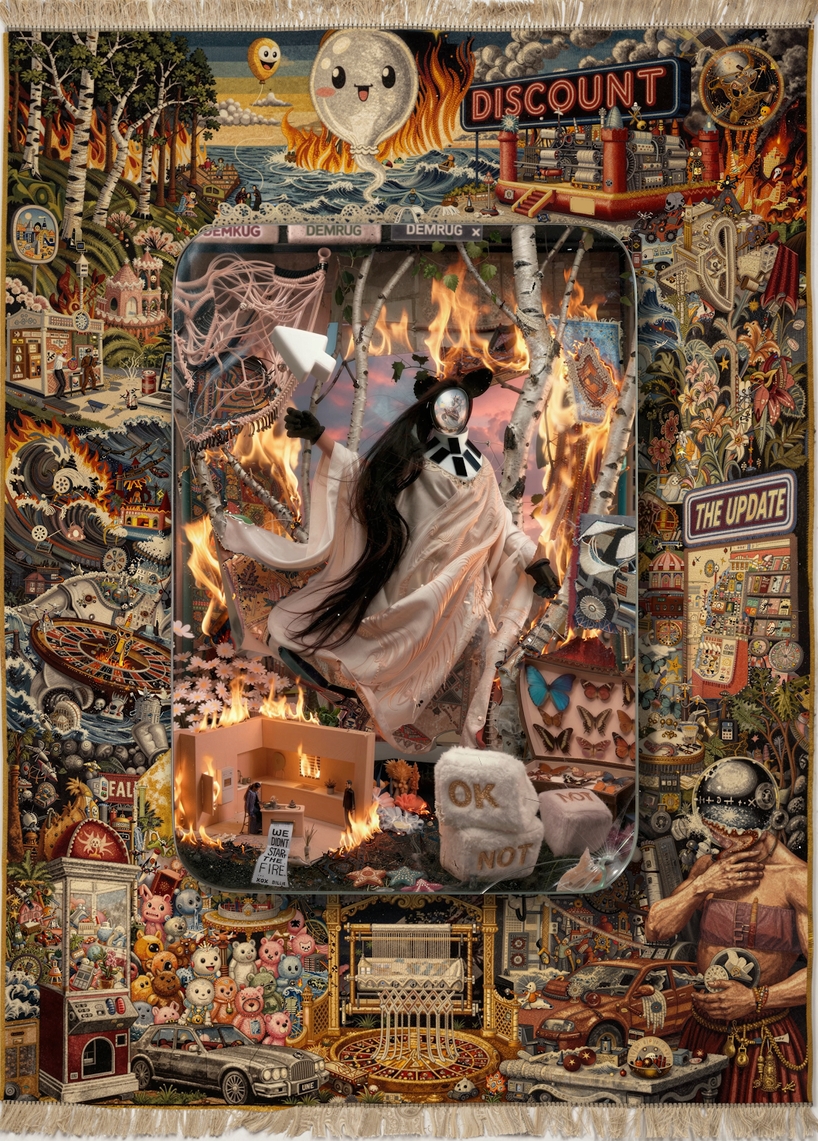
That there are seven hangings is no coincidence. In gnostic-hermetic cosmology the soul descends through seven planetary spheres, taking on a vice at each stage, and sheds them again on the way back up. Seven stations of the fall, seven of the ascent. The series follows that path: HOME SWEET HOME (self-deception), THE DISCOUNTER and THE DOOMSCROLLER (the descent), WELCOME TO SLOPLAND (the abyss), THE GLITCH (the rupture), THE METAMORPHOSIS (reconstruction), and THE UPDATE — the old status quo in new garb, and at the same time the seed of the next fall. The glitch is the decisive rupture: the malfunction through which the system briefly gives away its own construction.
At the centre of each episode stands the same figure, its face sealed by a striking mirror mask. The mask conceals the figure’s identity while becoming a projection surface for the viewer. It has a precise source: in the hermetic Poimandres, the primordial human falls into the material world because he catches sight of his own beautiful reflection there and falls in love with it. The fall begins not with guilt but with self-infatuation. The mirror mask repeats exactly this: whoever looks into it sees themselves — and, like the primordial human, falls in love with their own image. In the age of the selfie and the feed, this is the original fall in its purest form. And the mirror does not stay passive: it throws viewers back upon themselves. They do not stand at a safe distance before the scene but inside the picture — implicated, not devout.
The force driving this rise and fall is Eros — and ZEITGEIST deliberately gives it two faces. As the Demiurge’s instrument, it is Eros that drags us downward, binding us to images, objects and desire. At the same time, in the Platonic tradition of Diotima’s ladder, it is the only force that lifts us back up. This is the work’s actual thesis: the very force with which the Demiurge captures us is the force that carries us through the rupture and out of the emptiness. Seduction and salvation share a single instrument.
The material plays the same game. The hangings are not woven but printed on woven fabric — they merely feign the elaborate craft of tapestry. This feigning is intentional, and it is the sharpest trap in the work: the print counterfeits handwork, aura and centuries of labour where none of it exists. The medium thus enacts the very seduction it depicts — a beautiful surface promising fullness and delivering emptiness, exactly like the feed. Form and content collapse into one another. The imagery lives off the same incongruity: sacred compositions drawn from religious painting across several epochs are transposed into the banal consumer interiors of the Global North. Camp becomes a critical method here — it is the break between altarpiece and discount-store interior that produces the critique.
There is no resolution at the end. The figure has completed the path, wears its new garb — and still holds out to us the blank surface of its face. Anyone who recognises themselves in it has already taken the first step, for recognition is not the end of the fall but its beginning. The Demiurge needs no lie to keep us. The truth will do, so long as it is beautiful enough. And so a single question remains open, addressed not to the figure but to us: not whether we will fall again, but which of the seven episodes we are standing in right now.
ZEITGEIST, 2026
Siebenteilige Serie
Digitaldruck auf Duchesse-Satin, handgenähte Bordüren und Säume, Wandhalterungen aus Aluminium (Sonderanfertigung)
Je 140 × 200 cm
ZEITGEIST besteht aus sieben textilen Wandbehängen, die zusammen ein einziges, geschlossenes Narrativ bilden. Die Reihe erzählt die Phasen einer Bewältigung: von der anfänglichen Selbsttäuschung über den Niedergang bis an den Abgrund, wo ein entscheidender Riss den Neuaufbau erzwingt — zurück zum alten Status quo, aber im neuen Gewand und mit neuer Erkenntnis. Der Bogen schließt sich. Und darin liegt seine Pointe: Er schließt sich nur, um von vorn zu beginnen.
Denn ZEITGEIST behauptet, dass es in der spätdigitalen Gegenwart kein trautes Heim ( Fülle/Pleroma) mehr gibt, in das man zurückkehren könnte — keine endgültige Erlösung, keinen Ausstieg aus dem Kreislauf. Es gibt nur den nächsten Patch. Jede errungene Erkenntnis wird so zur Sprosse für den nächsten Abstieg. Was die klassische Gnosis als einmalige Heimkehr dachte, kippt hier in eine ewige Wiederkehr — Nietzsche, gekreuzt mit dem Update-Zyklus.
Die Arbeit bezieht sich auf die Idee einer Tech-Gnosis, angelehnt an spätantike Religionsphilosophie und Gnosis mit ihrem Dualismus: Einem fernen, transzendenten Gott steht ein niederer Schöpfergott gegenüber, der Demiurg. In den alten Quellen ist dieser Demiurg vor allem unwissend und hochmütig. ZEITGEIST liest ihn bewusst um — als den verführerischen Schöpfergott des Feeds: den Algorithmus, die Plattform, die Dopamin-Schleife. Er lockt den Menschen und lässt ihn zwischen Leere (Kenoma) und Fülle schwanken. Seine Werkzeuge heißen Technosolutionismus, Mediensucht, Konsum, Greenwashing, Sehnsucht.
Dass es sieben Behänge sind, ist kein Zufall. In der gnostisch-hermetischen Kosmologie steigt die Seele durch sieben Planetensphären herab und nimmt dabei Stufe um Stufe die Laster an; auf dem Rückweg streift sie sie wieder ab. Sieben Stationen des Falls, sieben des Aufstiegs. Die Reihe folgt diesem Weg: HOME SWEET HOME (die Selbsttäuschung), THE DISCOUNTER ( das Zulassen ) und THE DOOMSCROLLER (der Abstieg), WELCOME TO SLOPLAND (der Abgrund), THE GLITCH (der Riss), THE METAMORPHOSIS (der Neuaufbau) und THE UPDATE — der alte Status quo im neuen Gewand und zugleich der Keim des nächsten Falls. Der Glitch ist der entscheidende Riss: die Störung, durch die das System für einen Moment seine eigene Konstruktion preisgibt.
Im Zentrum jeder Episode steht dieselbe Figur, deren Gesicht eine markante Spiegelmaske verschließt. Die Maske verbirgt ihre Identität und wird zugleich zur Projektionsfläche für die Betrachtenden. Sie hat eine genaue Quelle: Im hermetischen Poimandres stürzt der Ur-Mensch in die materielle Welt, weil er dort sein eigenes schönes Spiegelbild erblickt und sich in es verliebt. Der Fall beginnt nicht mit einer Schuld, sondern mit Selbstverliebtheit. Die Spiegelmaske wiederholt genau das: Wer in sie blickt, sieht sich selbst — und verliebt sich, wie der Ur-Mensch, in das eigene Bild. Im Zeitalter der Selbstinzenierung ist das der Urfall in Reinform. Und der Spiegel bleibt nicht passiv: Er wirft die Betrachtenden auf sich zurück. Sie stehen nicht in sicherer Distanz vor der Szene, sondern mit im Bild — verstrickt, nicht andächtig.
Die Kraft, die dieses Auf und Ab antreibt, ist der Eros — und ZEITGEIST gibt ihm bewusst ein Doppelgesicht. Als Werkzeug des Demiurgen ist er es, der uns nach unten zieht, der uns an Bilder, Dinge und Begehren fesselt. Zugleich ist er, in platonischer Tradition als Diotimas Leiter, die einzige Kraft, die wieder emporhebt. Das ist die eigentliche These der Arbeit: Es ist dieselbe Kraft, mit der der Demiurg uns einfängt, die uns durch den Riss auch aus der Leere heraushebt. Verführung und Erlösung teilen sich ein Werkzeug.
Und das Material spielt dasselbe Spiel. Die Behänge sind nicht gewebt, sondern auf Webstoff gedruckt und textilen Aufbauten versehen — sie täuschen die aufwändige Bildwirkerei nur vor. Diese Vortäuschung ist Absicht und die schärfste Falle der Arbeit: Der Druck gaukelt Handwerk, Aura und jahrhundertealte Mühe vor, wo nichts davon ist. Damit vollzieht das Medium selbst die Verführung, die es darstellt — eine schöne Oberfläche, die Fülle verspricht und Leere liefert, ganz wie der Feed. Form und Inhalt fallen zusammen. Auch die Bildsprache lebt von dieser Inkongruenz: Sakrale Kompositionen aus der religiösen Malerei verschiedener Epochen werden in die banalen Konsuminnenräume des Globalen Nordens übersetzt. Camp wird hier zur kritischen Methode — erst der Bruch zwischen Altarbild und Discounter-Interieur erzeugt die Kritik.
Am Ende steht keine Auflösung. Die Figur hat den Weg hinter sich gebracht, sie trägt ihr neues Gewand — und hält uns weiterhin die blanke Fläche ihres Gesichts entgegen. Wer sich darin wiedererkennt, hat den ersten Schritt bereits getan, denn das Erkennen ist nicht das Ende des Falls, sondern sein Beginn. Der Demiurg braucht keine Lüge, um uns zu halten. Die Wahrheit genügt, wenn sie nur schön genug ist. So bleibt am Schluss eine einzige Frage offen, und sie richtet sich nicht an die Figur, sondern an uns: nicht, ob wir wieder fallen werden, sondern in welcher der sieben Episoden wir gerade stehen.
Dank geht an Anett und Lena, die an die Arbeit geglaubt haben.
Dank geht auch an Hanah für das textile Finish. https://handwerkstatt-ka.de/
Dank auch an Elaine für die Muse der #4