SKIN V
Interactive full-body installation based on a depth camera system shows digital bodies generated in real time.
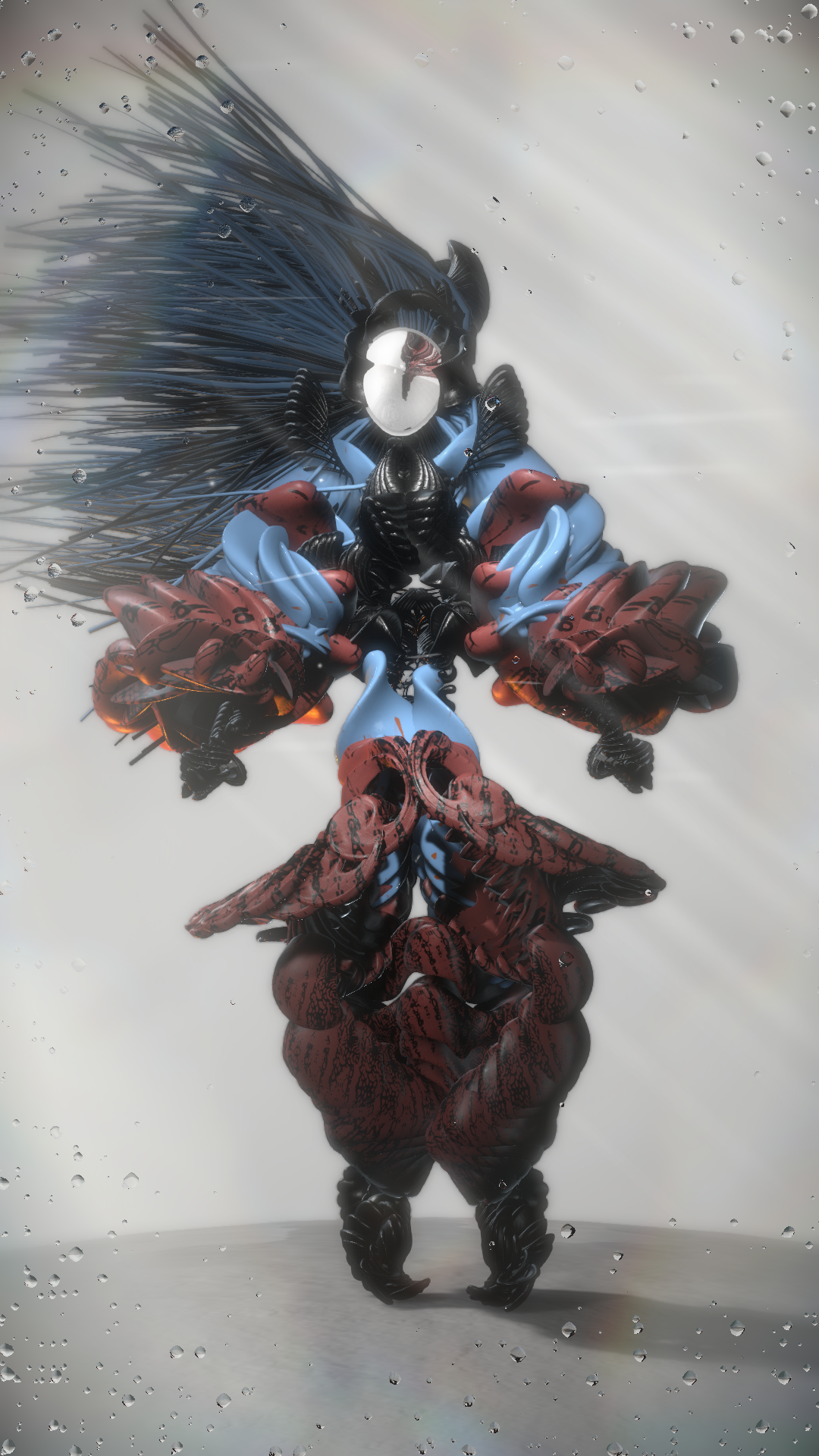
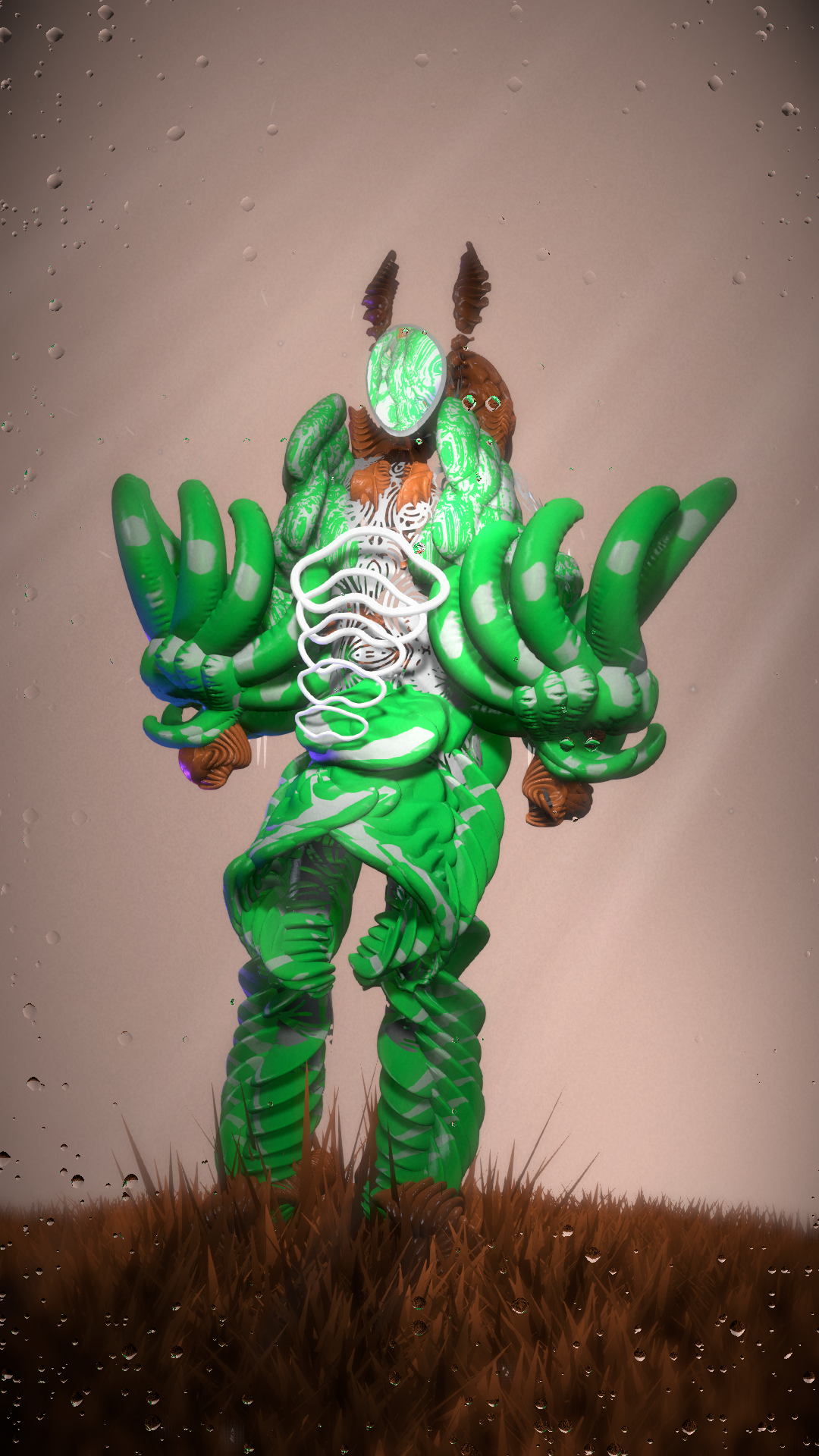
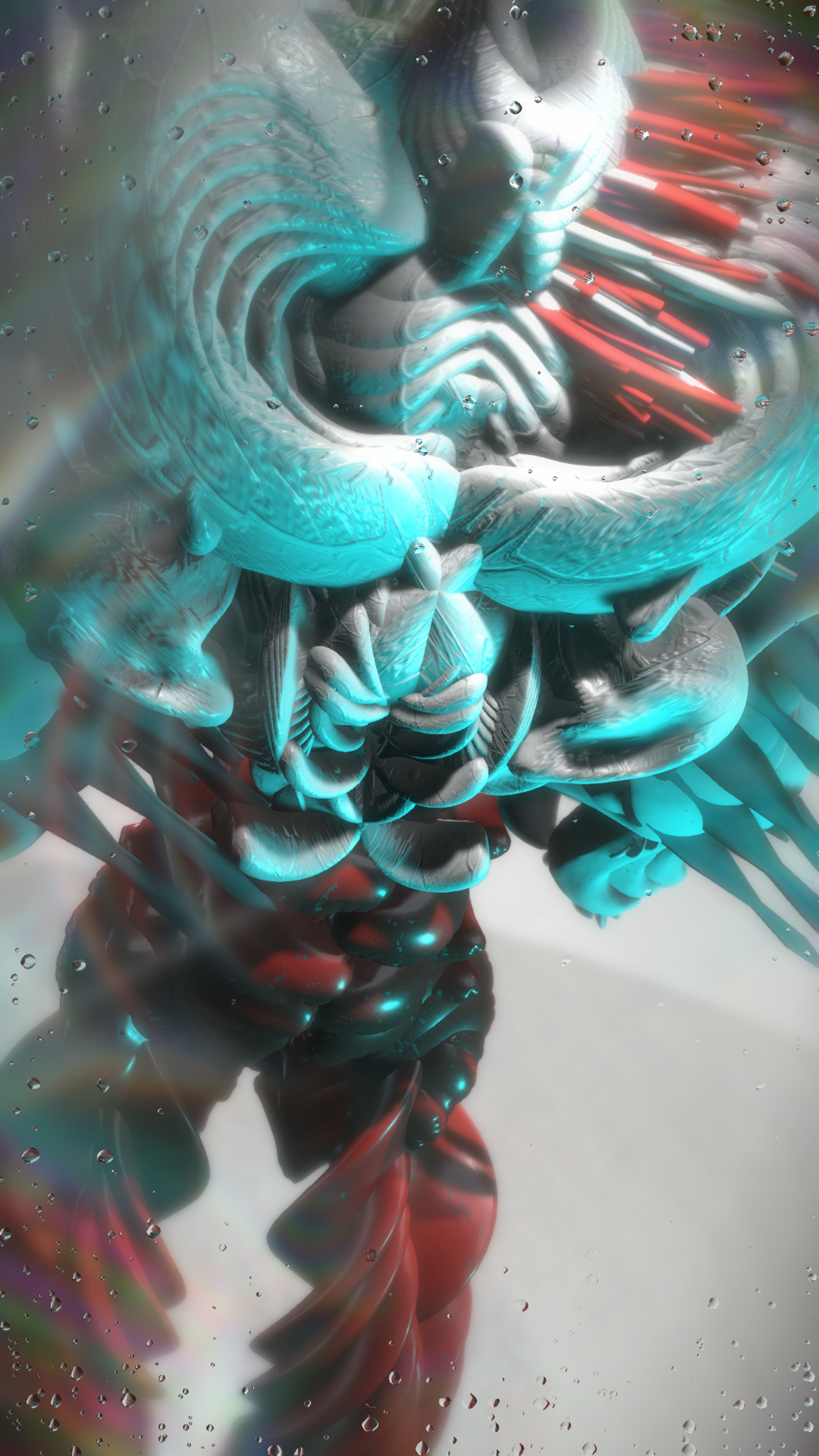
SKIN V is an interactive full-body installation based on a depth camera system and corresponding screen projections. The work generates digital humanoid bodies in real time that the user can control with their body movements. Based on rough biometric data from the user, a matrix of algorithms generates a body—always unique—along with the corresponding digital environment.
SKIN V, 2026
Three-channel real-time body tracking installation
Depth camera, computer, three screens, hand-drawn and printed carpet
Dimensions variable
Artist Statement
The human body consists, to a significant extent, of „non-human“ material. Billions of microorganisms – bacteria, fungi, viruses – colonise the skin, the mucous membranes and, in particular, the gut. Without these organisms, humans would not be able to survive: digestion, the immune system, metabolism and even emotional states are inextricably linked to microbial processes. The body is therefore not an autonomous, self-contained system, but an open structure, a habitat that functions solely through symbiosis. Identity arises not in spite of this interpenetration, but through it.
This understanding contradicts a body image that has dominated Europe since the early modern period. Since Descartes and La Mettrie, the body has been conceived as a mechanical system: repairable, optimisable, replaceable. Transhumanism and the enhancement fantasies of the present continue this line – the human as a technical object improved by prostheses, chips or software. Such a conception presupposes separation: here the human, there the tool; here the subject, there the environment. It is worth noting that this separation is historically and geographically specific. Chinese correlative cosmology, among others, never conceived the body as a closed apparatus, but as a permeable microcosm continuous with its surroundings.
The symbiotic understanding of the body reverses the mechanical logic. The body is not a machine, but a living infrastructure, an ecological network of human and non-human actors. This insight is not new: Lynn Margulis, Donna Haraway and Bruno Latour formulated it decades ago, and biology has long since confirmed it. Nor is this knowledge repressed today. It circulates as fermentation, gut flora and microbiome content, and is thoroughly commodified. What is missing is not information, but the moment in which this knowledge becomes physically noticeable.
SKIN V – The Body as an Ecological Mirror
SKIN V is the fifth work in the SKIN series and was developed specifically for the exhibition at the Suzhou Museum of Contemporary Art. The work conceives of the body not as an individual shell, but as a symbiotic habitat, and thereby questions a culturally learned understanding of body, identity and autonomy.
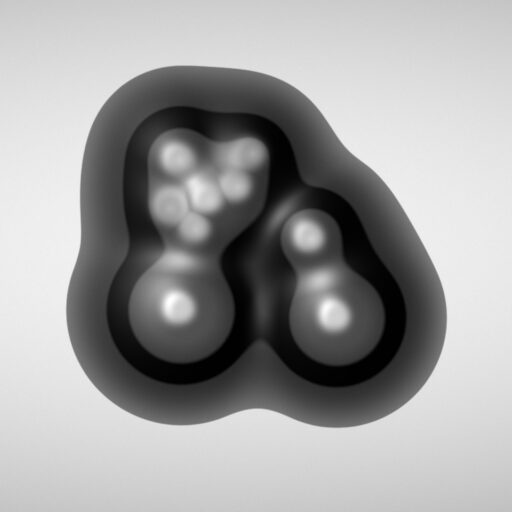
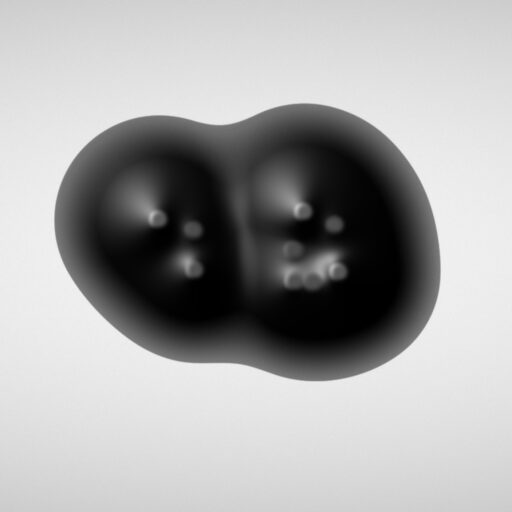
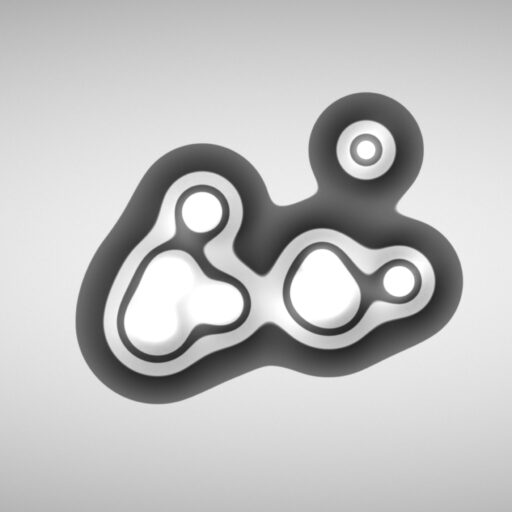
SKIN V works with digital mirror images generated through real-time body tracking. These mirrors do not show an idealised or optimised version of the body, but visualise it as a living ecosystem. Plants and fungi inspired shapes grow on the skin, beneath the skin, penetrate the body and intertwine with it. The body no longer appears as a self-contained unit, but as a transitional zone, a habitat for other life forms.
This imagery is a translation, not an illustration. Nothing photosynthesises in the human gut. Plants and fungi inspired shapes stand in for organisms that are too small, too numerous and too unspectacular to be perceived. The visible flora is a stand-in for an invisible population – and thus, at the same time, a commentary on the fact that our images of „nature“ are almost always images of the charismatic and the macroscopic.
The apparatus employed is deliberately the wrong one. Real-time body tracking, mirror image and figure recognition are the technical foundations of the beauty filter, an infrastructure built to smooth, slim and correct. SKIN V uses this machinery against its purpose: instead of an optimised reflection, an inhabited one appears. In this sense the mirrors do not function as futuristic interfaces of technical enhancement, but as instruments of uncertainty.
The work does not idealise symbiosis. Coexistence includes parasitism, dysbiosis, sepsis and autoimmune reactions; an antibiotic saves a life and simultaneously extinguishes an entire population in the gut. Nor is symbiotic dependency evenly distributed – whose microbiome remains intact is a question of water, food, medical care and money. What SKIN V shows is not harmony, but negotiation with an uncertain outcome.
One contradiction the work cannot resolve, and does not attempt to conceal: the mirror addresses a single viewer and returns to them an image of themselves – precisely the individualised self-perception that the work calls into question. SKIN V does not evade this. It makes use of it, because the dissolution of the individual body can only be felt where an individual is standing.
The title refers to the skin because the skin is the membrane most reliably mistaken for a boundary. It is not a wall, but a surface of exchange, densely populated, permeable, porous. It marks the place where the negotiation taking place inside the body becomes briefly visible. In this way, SKIN V marks a break not with the cyborg, but with the transhumanist promise of improvement. The work does not envision a future of a better, more efficient human being, but confronts a present in which humans are not alone – and never were.
SKIN < – Installation at the Suzhou Museum of Contemporary Art
At the Suzhou Museum of Contemporary Art, SKIN V is installed on a long wall beneath a staircase. The staircase cuts a diagonal through the space and across the work – an architectural line that the installation adopts and reinterprets.
This diagonal is read as a diagram of the emergence of life: from birth to cell, from cell to organism, from organism to environment, and further into an open, unbounded space. The arc is taken up by a hand-drawn and printed carpet that runs along the floor beneath the diagonal and at the same time defines the tracking area of the installation. Whoever wishes to see themselves in the mirror must enter this diagram.
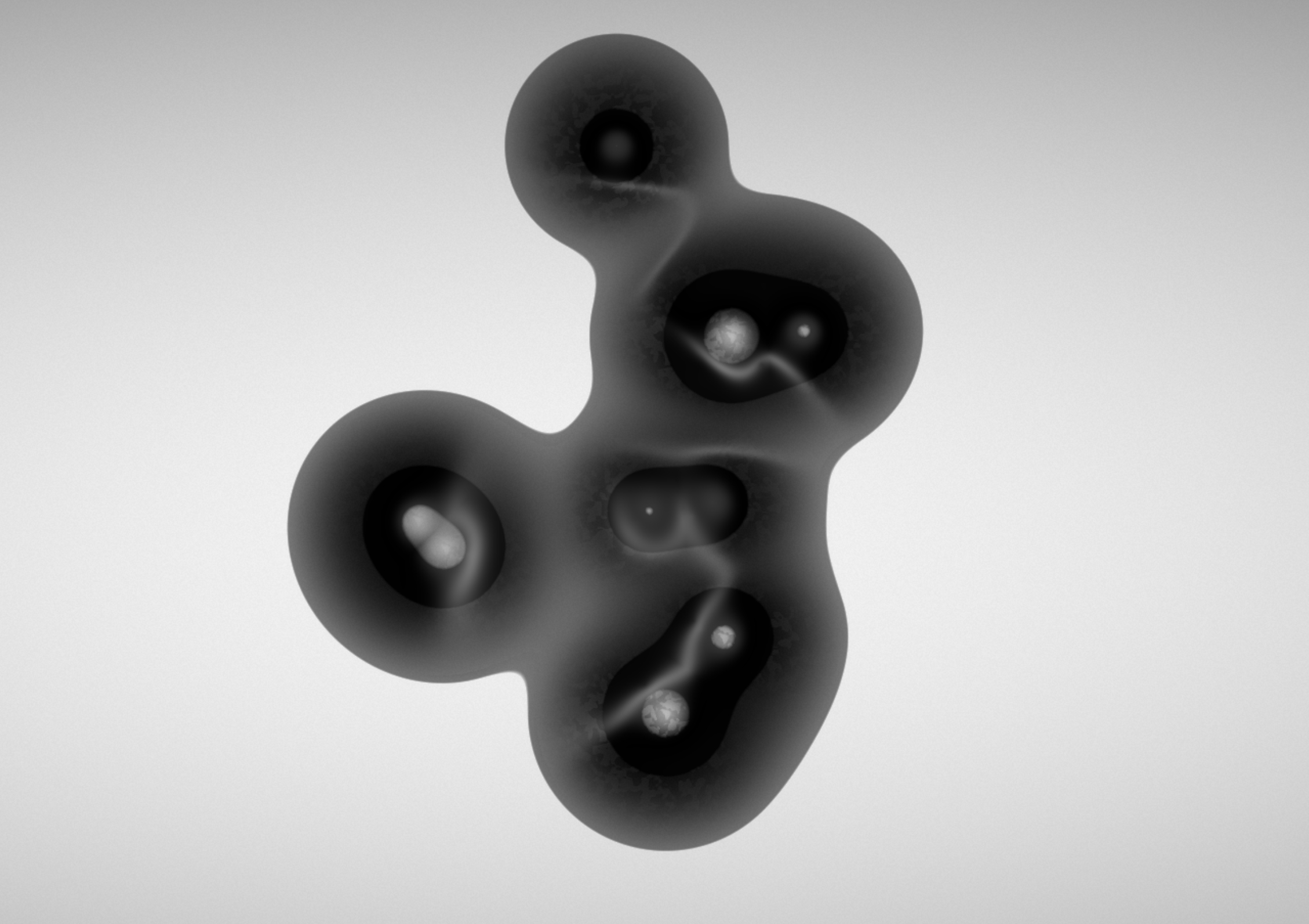
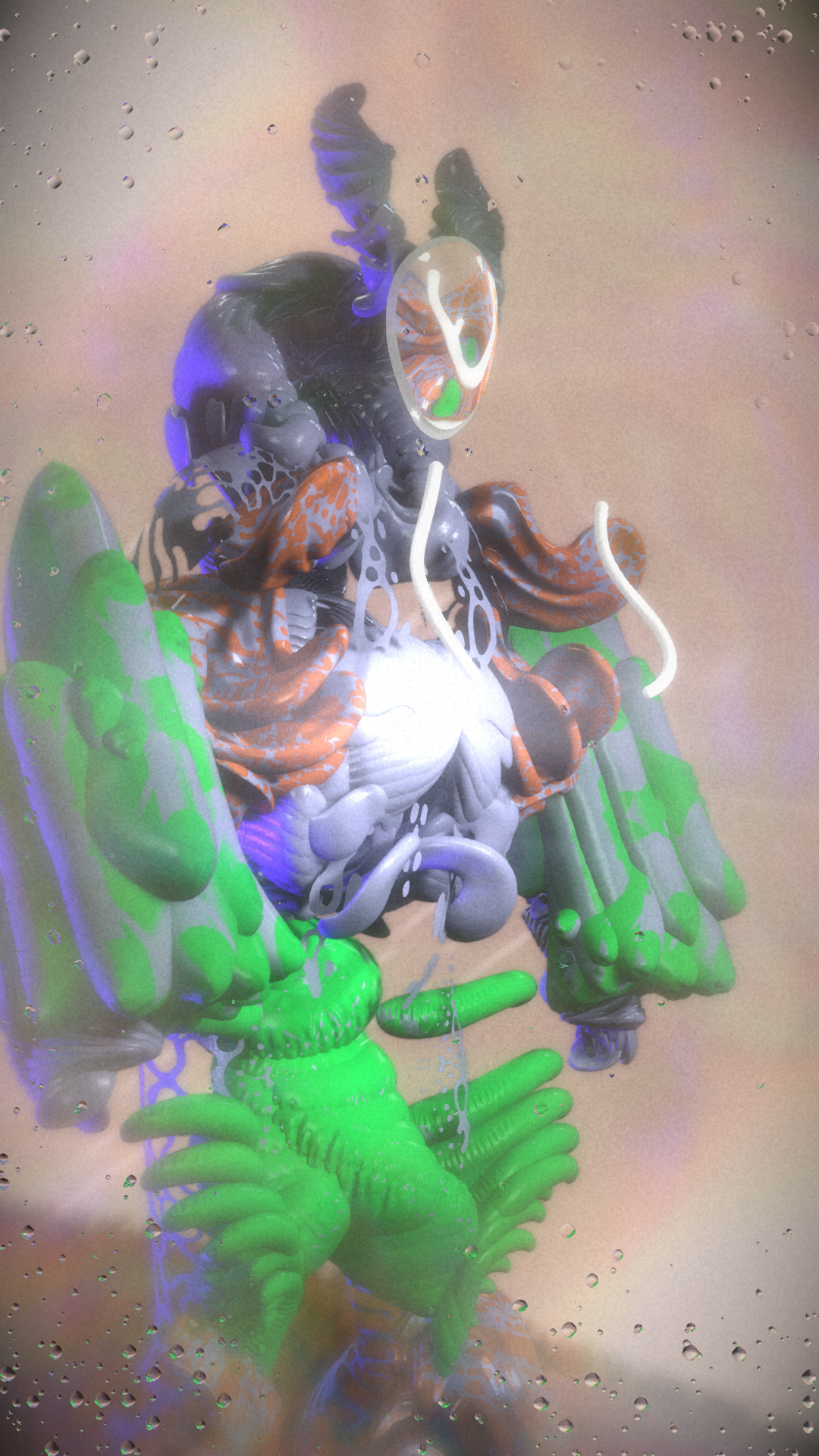
The title of the work follows this architecture. The numeral V, turned onto its side, becomes the sign <: the angle of the staircase, the opening figure of the diagonal, a bracket that does not close. SKIN V thus becomes SKIN < – the literal translation of the title into architectural form. The diagonal is concluded by a second work. SKIN CELL is a generative, shader-based program that continuously produces cellular patterns. These patterns are not decoration, but source material: they serve as blueprints for the visual system of SKIN V. At the end of the arc stands the cell – the starting point of the diagram – as an ongoing, non-repeating process. The work SKIN V addresses precisely this shifting self-perception. It conceives of the body not as an individual shell, but as a symbiotic habitat, thereby deconstructing our deeply ingrained cultural understanding of the body, identity and autonomy. At the same time, it reveals just how far our self-image is removed from the actual ecological nature of our existence.
SKIN V works with digital mirror images generated using AR technology. These mirrors do not show an idealised or optimised version of the body, but visualise it as a living ecosystem. Plants and fungi inspired shapes grow on the skin, beneath the skin, penetrate the body and intertwine with it with typical growth patterns we find in nature, like logarithmic or Vronoi logic. The humanoid body is recognizable and move along the motion of the user but is also slightly transformed, overgrown or hollow – like a blink of an eye of body-horror. The body no longer appears as a self-contained unit, but as a transitional and vunerable zone and as part of a bigger habitat with and for other life forms.
The AR mirrors do not function here as futuristic interfaces in the sense of technological enhancement, but as instruments of uncertainty. SKIN V shifts the focus from the body as an object of full control and power to the body as a place of coexistence. The focus is not on progress, optimisation or overcoming limitations, but on coexistence, permeability and the loss of control. In this sense, SKIN V marks a clear break with classic cyborg narratives. The work does not envision a future of a better, more efficient human being, but confronts us with a present in which humans are no longer alone – and never were. The body appears as a fragile, living infrastructure that can only exist as long as its symbiotic relationships remain intact.
SKIN CELL
SKIN CELL, 2026
Generative shader-based real-time program
Screen, computer