MIMICRY
Experimental Generative Systems and Bio-Materiality Toolkit
MIMICRY is a series of experimental prototypes at the intersection of body enclosures, generative design and material research. It asks how biological structures — mycelium, algae, rhizomatic root systems — can enter the design process not as visual reference but as active constraints on form and material. At its centre stands the relationship between form, function, and the limits imposed by body and matter: garment structures that are grown rather than assembled, and parametric mono-material solutions that achieve flexibility, insulation or medical support through geometry alone.
AUTHORED EMERGENCE
MIMICRY does not automate design. It produces authored emergence. The designer defines a field — seeds, obstacles, density gradients, painted directly onto the body mesh — and the system resolves that field into geometry no hand would draw. Full autonomy is not the goal and not the interest. What the tools offer is a partner that answers a question the designer has posed, in a form the designer could not have anticipated.
The second author is the material. In the planned architecture, material does not comment on a finished design; it supplies the constraints the growth must obey while it is still growing.
ANALOGY AND LINEAGE
The structures used here — Voronoi cells, Delaunay networks, flow fields, flocking agents — are borrowed from computational shape generation, where they are established practice for producing printable mono-material parts. Their biological reference is analogical. Their geometric lineage is not speculative.
This distinction matters. The prototypes do not simulate biology and make no claim to scientific validity. What they introduce is growth as a stage within the design process, positioned between parametric modelling and biological fabrication. Growth is a method here, not a property of the finished object. Nothing in this series repairs itself. The tools model how a grown structure could be directed, not the growing.
MONO-MATERIAL
The ecological argument of the project is geometric. Conventional functional clothing achieves its properties by lamination — layers of different materials bonded together, which makes recycling a separation problem and composting impossible. If flexibility, insulation and structural reinforcement can instead be produced by varying the geometry of a single material across the body, the object can be recycled or composted whole.
This is a testable claim rather than a slogan, and the planned material bridge is designed to test it.
ACCESS
Parametric body design has been locked for decades behind expensive licences and workstation hardware. The MIMICRY prototypes run in a browser tab. No installation, no build step, no subscription, no dedicated GPU — a school laptop is sufficient. All tools and outputs are released into the public domain under CC0, usable and modifiable without attribution.
Each prototype exports standard 3D geometry for further work in third-party software.
PROTOTYPES
Several standalone, theme-based prototypes, each taking either a specific question as a starting point or exploring bio-materiality and physical phenomena through simulation and design-focused construction. All share a common architecture: a single self-contained HTML file, Three.js, a pose system with bone dragging, bilateral symmetry, painted vertex maps, and GLB import and export.
RHIZOMORPHIC DESIGNER — An experimental tool for living wearable systems and root-grown textiles. Root-inspired agents expand across the body surface, searching, splitting, weaving and fusing according to painted seed, obstacle and preference maps, with cylindrical growth constraints. The output is anisotropic and path-continuous.
CELLULAR HULL DESIGNER — Generative cellular hull designer for wearable systems. Voronoi, Delaunay and hexagonal structures grow under hand-painted heatmaps that accelerate, guide or constrain them, targeting local flexibility, heat conservation and structural performance where the body requires it. The output is an isotropic cell network.
FLOWFIELD RIPPLE DESIGNER — Flow field and generative ripple design tool on the body surface, translating directional fields into dune and ripple behaviour across the form.
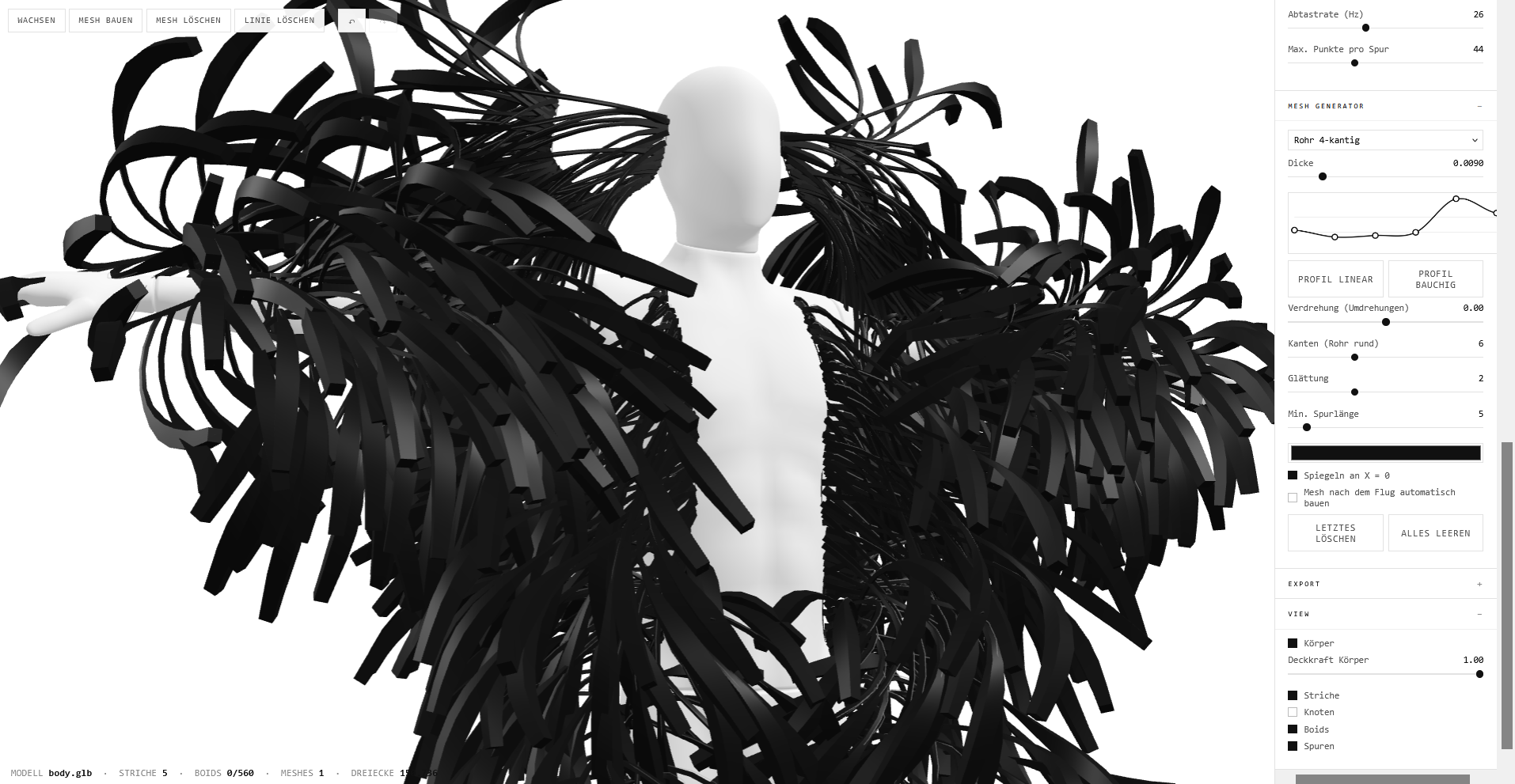
BOID WEAVER — Boid flocking based design tool using swarm motion as an outfit hull design method. Freely drawn splines seed hundreds of autonomous agents whose trajectories become geometry, with curve-based thickness control along each spline. The output is directional and close to fibre paths.
MATTER — MATERIAL DATABASE
A key foundation of artistic design research is the involvement and questioning of the design material itself. MIMICRY therefore comes with a custom material database, fed with common materials but mostly with biomaterials and compostable materials. Conventional entries such as aluminium and carbon fibre stand alongside chitosan, flax fibre and mycelium. A network module uses generative, agentic tools to show possible combinations and interweavings in chemical, mechanical or traditional ways, with materials analysed and algorithmically linked by connection type.
Detailed information: https://tristanschulze.de/matter
Online prototype: https://matter.turboflip.de
UNCERTAINTY AS DATA
Biological materials have no reliable point values. The mechanical properties of mycelium vary by an order of magnitude depending on species, substrate, pressing, growth duration and drying protocol. A single figure for its strength is neither conservative nor optimistic — it is meaningless without its process.
MATTER therefore stores no property as a number. Each is held as a range together with its process context, its sources, and a confidence tier: measured values, which are numeric, cited, and the only tier permitted to drive a calculation; referenced values from literature and wiki sources, displayed with their origin; and speculative relations, where the generative model may propose combinations and hypotheses but never values.
One rule holds the system together: the generative model never emits a number that enters a calculation. Its legitimate work is extraction from sources with citation, not generation. The result is that the network module becomes a map of the boundary between the known and the merely plausible, with uncertainty shown as width rather than concealed behind false precision.
THE BRIDGE — PLANNED
The connection between the design tools and the material database is designed but not yet implemented.
Every generated mesh will export a fingerprint alongside its geometry: minimum strut diameter, maximum unsupported span and overhang angle, total strut length, volume and mass in grams, tightest bend radius, topology class, skin contact area, coverage, deviation from the painted target, and the stiffness ratio the design demands between its densest and sparsest regions.
This fingerprint runs the bridge in both directions.
From geometry to material, the fingerprint queries MATTER by measurable property rather than by description: which materials can hold this feature size, tolerate this strain, and be produced by an accessible process. Because this is a database query, no hallucination is possible. Its central case is the mono-material feasibility check. Where a design demands a stiffness ratio of 120:1 across the body and the chosen material through that lattice can deliver 40:1, the system reports the gap and offers three moves — change the geometry, change the material, or split into two. The mono-material claim becomes computable.
From material to geometry, the selection of a material rewrites the growth parameters before the simulation runs. Mycelium raises the minimum strut diameter to roughly eight millimetres, forbids overhangs, requires a mold, introduces a two-week growth period and compensates for around twenty percent drying shrinkage, producing closed surfaces rather than filigree. Fused deposition sets a 0.4 millimetre floor, a 45 degree overhang limit and directional weakness between layers. Chitosan films permit sheets but no lattice. Flax with bio-resin demands continuous fibre paths, which makes BOID WEAVER the appropriate tool and Voronoi the wrong one.
This second direction is the literal mechanism of material as co-author, and it is what turns four separate prototypes into a single system.
DECAY — PLANNED
A further planned feature gives the project its temporal dimension without resorting to speculation. Each material in MATTER carries end-of-life attributes: disposal route, time to degrade, and the conditions degradation requires. The tools will then run generated geometry forward in time. Struts thin, fall below threshold and disappear; the hull fails progressively; a counter runs alongside.
Growth in real material cannot yet be honestly simulated. Decay can, because it rests on documented figures. It also states the ecological position more precisely than any disclaimer: the problem was never making things, but what persists afterwards. A nylon variant counting four hundred years beside a chitosan one counting ninety days is the argument in a single image.
LICENCE
All tools, outputs and data developed within MIMICRY are released into the public domain under CC0, freely available for use, modification and redistribution without any attribution requirement. The codebases were produced through agentic coding workflows and are published for further research in speculative and computational design.